Article
Written by
Please note the content is for informational purposes only and not to be relied on
Why Most CFO Hires Go Wrong (And How Boards Can Avoid It)
Why Most CFO Hires Go Wrong (And How Boards Can Avoid It)
When a CFO hire fails, it is rarely because the candidate lacked ability.
In most cases the individual was experienced, technically strong and well regarded in previous roles. On paper the hire made perfect sense.
Yet within 12 to 24 months the situation begins to unravel. Decisions slow down. Tension appears between CEO, board and finance. Strategic progress stalls.
The instinctive explanation is that the individual was the wrong person. In reality the issue is usually something more subtle.
The business hired the wrong type of CFO for the moment it was in.
The real mistake organisations make
Most companies approach a CFO hire as a role definition exercise.
They write a specification.
They list responsibilities.
They identify technical requirements.
Then they go to market.
What often gets missed is the context.
A CFO is not simply a senior finance operator. The role is fundamentally about leadership and decision making at a specific point in a company’s journey.
A CFO who thrives in one environment can struggle in another that looks similar on the surface but demands completely different instincts.
This is particularly common in growth businesses, founder led companies and private equity backed organisations where the pace and complexity of change is high.
The mistake is assuming there is a single model of what a great CFO looks like.
There isn’t.
You are not hiring a CFO
A more useful way to think about the decision is this:
You are not hiring a CFO.
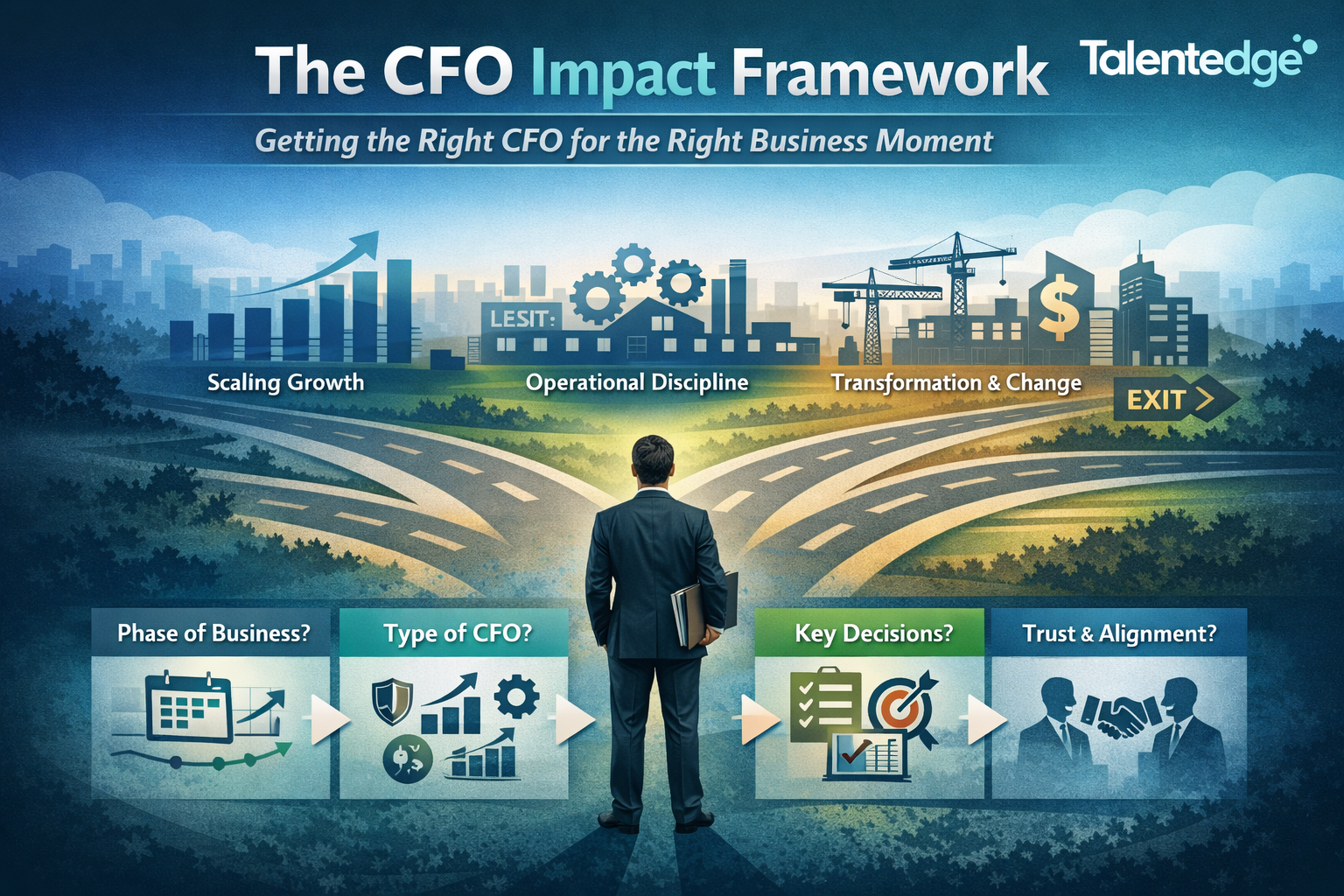
You are hiring leadership for a specific business moment.
That moment might be:
scaling a fast growing business
introducing stronger financial discipline after a period of expansion
transforming systems and processes
preparing for investment or exit
Each of these situations requires a different type of CFO.
Misdiagnose the moment and even a very capable finance leader can appear ineffective.
Four questions boards should ask first
Before any CFO search begins, boards and CEOs should align around four critical questions.
1. What phase is the business actually in?
Not the phase it was in two years ago. Not the phase investors hope it will reach.
The question is what the organisation will realistically face over the next 24 to 36 months.
Growth businesses often assume they need a strategic commercial CFO when the immediate challenge is actually building financial infrastructure and discipline.
In other cases companies recruit a steady pair of hands when the business really requires transformation.
Clarity on the phase of the business is the foundation of a successful hire.
2. What type of CFO fits that phase?
In practice most successful CFOs tend to fall into recognisable archetypes.
For example:
The steward who brings control, discipline and reliability
The commercial CFO who partners closely with the CEO on growth and strategy
The transformation CFO who rebuilds systems, teams and financial processes
The exit CFO who prepares the business for investment, transaction or liquidity events
None of these profiles are inherently better than the others. They simply create value in different situations.
The risk comes when a business hires one archetype while needing another.
3. Which decisions must improve because of this hire?
A strong CFO should materially improve the quality and speed of critical decisions.
Boards should ask themselves a simple question:
Which decisions will be better because this person is in the seat?
That might include:
capital allocation
commercial pricing decisions
investment prioritisation
investor communication
strategic planning
If that improvement is unclear, the role itself may not yet be clearly defined.
4. Who must trust this CFO quickly?
The success of a CFO rarely depends on finance capability alone.
It depends on influence.
In some businesses the most important relationship is with the CEO. In others it is with the board or investors. In founder led companies the dynamic can be even more complex.
Understanding where trust must be built quickly is critical to identifying the right leadership style.
Why this matters more than ever
CFO appointments have become more consequential over the last decade.
Finance leaders are now expected to operate across strategy, operations, investor relations and risk management. The role sits at the centre of many of the most important decisions a company makes.
When the hire is right, the impact can be transformative. Alignment improves. Decisions accelerate. Confidence builds across the leadership team.
When the hire is wrong, the consequences can be expensive and slow to correct.
In some cases organisations spend 18 months discovering that the CFO they appointed was simply the wrong fit for the moment they were in.
Creating clarity before the search begins
The most effective boards treat CFO hiring as a strategic alignment exercise before it becomes a recruitment process.
By diagnosing the business phase, identifying the right CFO archetype, clarifying the decisions that need to improve and understanding the trust dynamics around the role, organisations dramatically reduce hiring risk.
The search itself then becomes significantly easier.
Interviews become more focused. Stakeholders align faster. The probability of a successful appointment increases.
In other words, the most important work often happens before the role ever goes to market.
Because in CFO hiring, the biggest risk is not choosing the wrong candidate.
It is solving the wrong leadership problem.
See which firms have actually placed roles like this
Gathr tracks real placements across hundreds of search firms. Drop your email and we'll send you the data for companies like yours.